
Christmas has a habit of taking over our homes. Decorations emerge from cupboards, shopping bags multiply, furniture gets rearranged, and suddenly every available surface seems to require a festive ornament. We polish, scrub, decorate, illuminate and generally turn our homes into miniature Christmas wonderlands.
Before we start hanging the garlands and switching on the fairy lights, however, perhaps we should pause for a moment and consider something rather more fundamental. What kind of energy are we inviting into our homes?
In Feng Shui, the ancient Chinese practice of understanding the relationship between people and their surroundings, the concept of Chi (Qi) is central. Often described as vital energy or life force, Chi is understood as something that moves through our environment. Its movement, quality and balance are important considerations when examining a living space.
Christmas preparation therefore offers an excellent opportunity to do more than decorate. It allows us to reconsider how our homes function, how we use our spaces and what we want them to represent. After all, there is little point in creating a picture-perfect Christmas setting if the people living in it feel anything but comfortable.
Let’s begin with the basics.
Before welcoming the festive season, clear the decks
There is little point in inviting fresh energy into a home that is already struggling to accommodate everything it contains. Clutter is one of the first things to address when preparing a home according to Feng Shui principles. Objects that are broken, unwanted, neglected or simply taking up space can contribute to an environment that feels stagnant and uncomfortable.
Start with the places that tend to accumulate the most unnecessary belongings. Hallways and entrances often become convenient storage areas, while kitchen counters and dining surfaces gradually disappear beneath accumulated possessions. Cupboards can harbour things we haven’t used in years, and broken Christmas ornaments sometimes survive simply because nobody has got around to throwing them away.
Cleaning and decluttering are not quite the same thing. You can have an impeccably clean room that still feels overcrowded and energetically heavy. Open the windows, allow fresh air to circulate, clean the glass and let natural light into rooms that have become a little neglected. Pay attention to corners and spaces that rarely receive attention, too.
While sorting through your belongings, consider whether everything deserves a place in your future. Not every object needs to accompany you into another year. Sometimes the most effective way to make room for something new is to let go of something old.
There is something rather liberating about making space, both physically and symbolically, for a fresh beginning.
The entrance: Welcome Chi into your home
In Feng Shui, the main entrance is traditionally known as the mouth of Chi. It is considered an important point through which energy enters the home, making it an area that deserves particular attention.
Think about the first impression your entrance creates. Is it welcoming? Is it accessible? Can the front door open fully without colliding with shoes, parcels, umbrellas or an assortment of objects that have somehow migrated there?
A welcoming entrance does not require elaborate decoration. A clean, well-maintained door, adequate lighting and an unobstructed approach are far more important than an expensive Christmas display. A healthy plant, a seasonal wreath or an attractive doormat can introduce a little festive personality without overwhelming the space.
The hallway deserves attention as well. Its purpose is to allow movement between the entrance and the rest of the home, so an accumulation of furniture and belongings can make the space feel constricted. Consider how energy and people move through it, and whether anything is creating an unnecessary obstruction.
The intention is to create an inviting transition between the outside world and the sanctuary of your home. Your entrance does not need to resemble the foyer of a five-star hotel. It simply needs to feel welcoming.
Christmas decorations and the five elements
Now we can get to the fun part! Feng Shui recognises five elements: Wood, Fire, Earth, Metal and Water. These are not simply decorative categories but represent different qualities and relationships within the traditional system. Christmas provides an excellent opportunity to explore them, particularly because so many familiar seasonal decorations already reflect their symbolism.
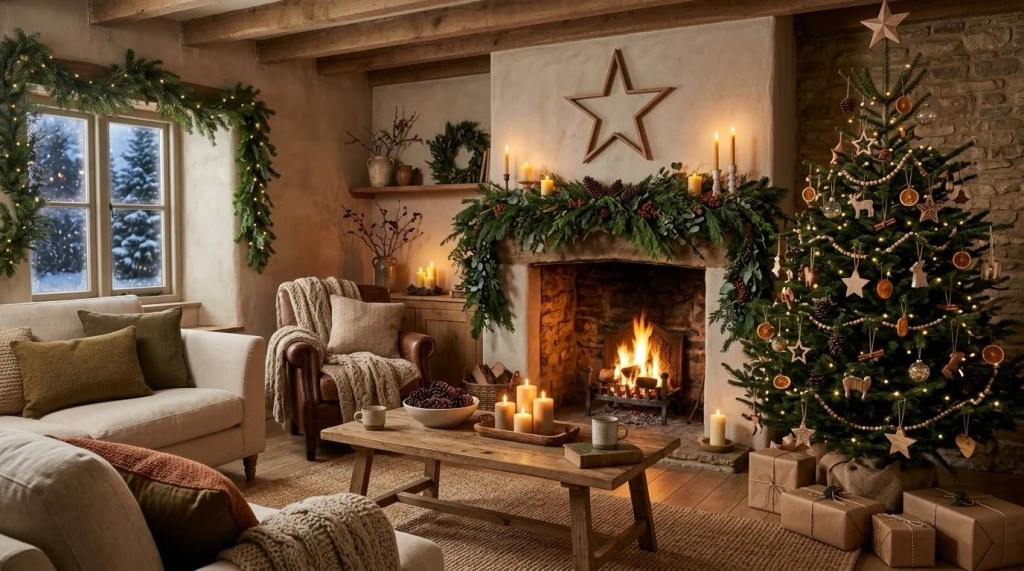
Wood represents growth, vitality and renewal. Evergreen branches, Christmas trees, wreaths, natural garlands and wooden ornaments introduce this element into our homes. There is something particularly appropriate about bringing living greenery indoors during the darker months, reminding us that nature continues its cycle of growth even when much of the landscape appears dormant.
Fire represents warmth, illumination, activity and recognition. Candles, fireplaces, lights and triangular shapes are associated with this element. Christmas is traditionally a time of celebration and social interaction, making Fire particularly prominent. Moderation is important, however. An entire room saturated with red, flashing lights and bright illumination can become visually overwhelming. A little festive sparkle is delightful; recreating the runway lighting of an international airport is perhaps less necessary.
Earth represents stability and nourishment. Ceramics, stone, terracotta, natural textures and earthy colours introduce this element into our surroundings. Think of the Christmas dining table, ceramic serving dishes, natural-coloured decorations and materials that create a sense of warmth and groundedness.
Metal is associated with clarity, precision and refinement. Silver, gold, metallic ornaments and circular shapes can introduce this element into Christmas decorating. A little metallic decoration can add elegance without requiring the entire Christmas tree to resemble a jewellery shop.
Water represents reflection, wisdom and the flow of life. Dark blue and black, glass, reflective surfaces and flowing forms are traditionally associated with this element. A dark blue ornament, a glass decoration or a reflective surface can introduce Water without installing a fountain in the middle of your living room.
The five elements operate through productive and controlling relationships. Wood feeds Fire, Fire generates Earth, Earth produces Metal, Metal supports Water, and Water nourishes Wood. Understanding these relationships helps explain why Feng Shui is concerned with balance rather than simply introducing more of whichever element we happen to like.
A Christmas tree, for example, introduces a strong Wood presence. Adding lights introduces Fire, while ceramic ornaments and natural stone decorations can bring in Earth. The objective is not to tick five decorative boxes but to create a considered and harmonious environment.
The fireplace: The heart of the home and the Fire element
For those fortunate enough to have a fireplace, Christmas provides an excellent opportunity to appreciate its place within the home. There is something wonderfully reassuring about a real fire. It draws people together, creates warmth and provides a natural focal point for conversation.
In Feng Shui, Fire is associated with warmth, vitality, illumination, activity and recognition. A fireplace can therefore be a powerful expression of the Fire element. Its placement, however, deserves some consideration when examining the home through Feng Shui principles.
Understanding fireplace placement
In traditional Compass School Feng Shui, the South is associated with the Fire element. A fireplace situated in this sector therefore has a natural elemental affinity. This does not mean that every fireplace elsewhere in the house is automatically problematic. The five-element relationships provide a more useful way of understanding the different placements.
The traditional directional associations are as follows:
| Direction | Element | Relationship with Fire |
|---|---|---|
| North | Water | Water controls Fire |
| Northeast | Earth | Fire generates Earth |
| East | Wood | Wood feeds Fire |
| Southeast | Wood | Wood feeds Fire |
| South | Fire | Same-element relationship |
| Southwest | Earth | Fire generates Earth |
| West | Metal | Fire controls Metal |
| Northwest | Metal | Fire controls Metal |
These relationships are starting points for understanding the interaction between the fireplace and its surroundings, rather than a simple list of good and bad locations.
Two ways to assess your fireplace: Bagua and Compass School
There are two approaches worth introducing because they are frequently confused in modern Feng Shui discussions. The Western BTB Bagua and the traditional Compass School use different reference systems, and understanding the distinction is important when applying them to an existing property.
The BTB Bagua – Black Sect Feng Shui
The BTB Bagua is a modern Western adaptation that aligns a nine-section energy map with the main entrance of the home. Standing at the entrance and looking into the property, the bottom row of the map corresponds with the entrance wall.
The nine areas represent different aspects of life: Wealth and Prosperity, Fame and Reputation, Relationships, Family, Health and Balance, Creativity and Children, Knowledge and Self-Cultivation, Career and Life Path, and Helpful People and Travel. Each area also has an associated element.
If your fireplace occupies the Fame and Reputation sector, for example, it sits in an area associated with Fire. A fireplace in one of the Earth sectors has a different elemental relationship, since Fire traditionally generates Earth. A fireplace in a Metal sector requires more consideration because Fire controls Metal.
The important point is that the BTB Bagua is aligned with the entrance, not with the compass. Its sectors should not be confused with the actual geographical directions.
The Compass School – Working with actual directions
The traditional Compass School uses the actual orientation of the property. A compass or, for more detailed analysis, a traditional Chinese Luo Pan is used to establish the relevant directions. The Bagua is then aligned with the geographical orientation of the home.
Here, North is North, South is South, and the elemental associations follow the compass directions. This is where the South becomes particularly significant because it is traditionally associated with Fire.
More advanced Compass School assessments may also consider the building’s facing and sitting directions, construction period and Flying Star calculations. These methods introduce additional layers of interpretation that go beyond simply identifying the direction in which a fireplace is situated.
The two systems should not be mixed casually to produce a convenient answer. They use different orientations and assumptions, and each needs to be applied consistently.
What if your fireplace is in the wrong place?
Here is where real life enters the discussion.
Most of us do not live in homes that were designed according to Feng Shui principles. We buy existing properties, inherit architectural decisions, renovate what we can afford and make the best of the space available. Relocating a fireplace is hardly a practical Christmas preparation exercise!
The answer is not to panic or declare your living room energetically doomed. Instead, consider how you can create balance within the existing layout.
A fireplace in a Water sector deserves particular consideration because Water and Fire have a controlling relationship. In a Metal sector, Fire controls Metal, so the surrounding materials and decorative choices become relevant. In a Wood sector, the Wood element feeds Fire, while an Earth sector has a naturally productive relationship with Fire.
These are starting points rather than universal prescriptions. The size of the fireplace, its use, the surrounding furnishings and the wider configuration of the home all matter. Natural materials, carefully selected colours, balanced lighting and thoughtful furniture placement can contribute to the overall atmosphere without turning the room into an experiment in elemental remedies.
One final consideration: mirrors, water features and decorative objects should not be introduced automatically as cures for an unfavourable placement. Their effect depends on the wider configuration and the Feng Shui school being applied.
A fireplace should also remain a practical and safe feature of the home. Keep the hearth maintained, the chimney properly serviced and combustible decorations at a safe distance.
The lesson is simple: work with the home you have. Feng Shui is about understanding relationships and creating balance, not achieving architectural perfection.
Creating harmony for family, friends and guests
Christmas brings people together, sometimes in rather greater numbers than our homes were originally designed to accommodate! The arrangement of furniture and the use of shared spaces can have a considerable influence on how comfortable people feel.
Consider your living room. Can people sit comfortably and converse without having to shout across the room? Are there clear pathways between seating areas? Does the furniture arrangement encourage interaction rather than isolate people?
In Feng Shui, the relationship between Yin and Yang is another important consideration. Yin is associated with qualities such as stillness, quiet, softness and rest, while Yang represents activity, brightness, movement and stimulation.
A Christmas gathering naturally introduces more Yang energy through conversation, activity, music, lighting and movement. The trick is to balance this with comfortable seating, softer lighting and spaces where people can retreat from the festivities when they need a little quiet.
The dining table deserves particular attention. It is more than a surface on which to place the Christmas dinner. It is a place of gathering, sharing and connection. Keep it accessible, avoid unnecessary clutter and make room for the people who will sit around it.
A beautifully decorated table is lovely. A table around which people feel welcome is considerably more valuable.
A word of caution: Leave the bedroom out of Christmas
There is a growing trend, particularly on social media, to decorate every available corner of the home for Christmas. Bedrooms are increasingly becoming extensions of the festive decorating extravaganza, complete with illuminated garlands, miniature Christmas trees, novelty bedding, decorative lighting and assorted seasonal accessories.
My advice from a Feng Shui perspective? Leave the bedroom out of the Christmas decorating competition.
The bedroom serves a different purpose from the living room, dining room or entrance hall. It is primarily a place of rest, recovery, intimacy and rejuvenation. In Feng Shui, the bedroom is generally associated with Yin energy: calm, quiet, softness and stillness.
Elaborate Christmas displays, flashing lights, bright colours and excessive ornamentation can introduce an unnecessarily active Yang influence. The bedroom should remain a place where the mind and body can settle, rather than another room competing for our attention.
This does not mean that your bedroom must become a festive-free zone devoid of warmth. A simple seasonal touch, such as a natural sprig of greenery or a subtle change in textiles, need not disturb the atmosphere. The principle is moderation, with particular attention to preserving the room’s restorative function.
Your bedroom is not a Christmas showroom. It is your sanctuary.
Perhaps that is one of the most important lessons of the season: not every space needs to participate in the festivities.
Making room for abundance, joy and connection
We often associate abundance with material possessions, prosperity and the accumulation of things. Yet abundance can take many forms. It can be a home filled with laughter, a table with enough food to share, a comfortable chair for an unexpected guest or the simple pleasure of spending time with people who matter.
Feng Shui encourages us to consider how our surroundings support the lives we lead. A home that is overcrowded, poorly maintained or arranged without consideration for the people living in it may not provide the atmosphere we wish to create.
Sometimes, creating abundance begins by removing what no longer serves us. Clear a space, let in some light, rearrange a room or make the entrance more welcoming. Allow the fireplace to become a gathering point rather than simply another decorative feature.
Remember that the five elements are not a shopping list. You do not need to purchase something representing each one to create harmony. You may already have everything you need.
Perhaps the greatest Christmas gift we can give our homes is a little attention, consideration and care.
A final thought
As we prepare our homes for Christmas, we spend considerable time thinking about what to bring in: decorations, presents, food, visitors and festive cheer. Perhaps we should spend just as much time considering what to let go of.
Feng Shui reminds us to pay attention to the relationship between our surroundings and the way we experience them. It encourages us to look at our homes not simply as collections of rooms and possessions, but as environments in which we live, rest, work, celebrate and connect.
We do not need perfect architecture, expensive decorations or a professionally designed interior to achieve that. We need a little awareness, a willingness to make adjustments and an understanding that balance is often found in the simplest things.
So, before you hang the next garland or purchase another box of Christmas ornaments, take a moment to look around your home. Does it welcome you? Does it give you room to breathe? Does it offer comfort, warmth and a sense of belonging?
If the answer is yes, you are already well on your way.
May your home welcome good Chi, your fireplace bring warmth, your table encourage connection and your Christmas be filled with abundance in all its forms.
Happy preparations, and may the festive energy flow!


Leave a Reply