Candles, crystals, cosy blankets and the curious human need to illuminate absolutely everything.
A Little Light, a Lot of Warmth
The autumn wind had begun to rustle the oak’s remaining leaves, sending them tumbling across the forest floor. Beneath its branches, the woodland residents had gathered for one of their last conversations before winter settled in.
The bear was already thinking about his den. A good bed of leaves, a few extra blankets, a comfortable corner and enough food to see him through the long months ahead. He considered this a sensible approach to winter-proofing, although the others suspected his definition of preparation involved considerably more cake than strictly necessary.
“The humans are busy preparing their homes, too,” the owl observed from a low branch. “They speak of warmth, comfort, positive energy and creating a peaceful environment for the colder months.”
“Blankets,” said the bear approvingly.
“Candles,” added the squirrel.
“Crystals,” said the rabbit.
“Darkness,” muttered the mole from his burrow entrance.
Everyone looked at him.
“Some of us,” the mole explained, “would appreciate it if the humans stopped turning every room, garden, balcony and shrub into a miniature sun.”
The squirrel looked wounded. “Fairy lights are cheerful.”
“They are a public nuisance to anyone trying to sleep underground.”
The owl cleared his throat. “Perhaps the point is not to illuminate absolutely everything, but to create an atmosphere that feels welcoming. A little light can make a dark evening feel less bleak. A familiar scent, a favourite blanket or a quiet ritual can help people slow down and feel at home.”
“Which is why I recommend a blanket large enough to cover an entire bear,” said the bear.
“Your recommendations are remarkably consistent,” the rabbit noted.
“Consistency is an important part of winter-proofing.”
The Smell of Home
The discussion turned to the other ways humans prepared their homes for the colder season. Some brought out cinnamon, cloves and dried orange slices. Others filled their rooms with the smell of baking, simmering soup or freshly brewed tea.
“Smell can bring back memories,” the owl explained. “A familiar fragrance may remind someone of a childhood kitchen, a beloved person or a place where they once felt safe. These little associations can make a house feel like home.”
The rabbit nodded. “I think home is partly the feeling that someone has thought about your comfort before you even arrive.”
The bear looked up. “So, if I prepare a large pot of soup and a cake, I am creating a welcoming atmosphere?”
“You are preparing lunch,” said the mole.
“Lunch can be atmospheric.”
The squirrel, meanwhile, was busy making a list of supplies. He had nuts, seeds, dried berries and enough emergency provisions to survive a winter of truly unreasonable proportions.
“Preparation gives you peace of mind,” the owl continued. “The same applies to the rituals people use to welcome a new season. Some light candles, some rearrange their rooms, some place crystals where they find them beautiful or meaningful. These practices can offer a sense of intention and calm, even though claims about crystals influencing energy are not scientifically established.”
“Meaning does not have to be measurable to matter to the person who finds it,” said the rabbit.
The owl inclined his head. “Precisely. The important thing is to understand what brings you comfort, rather than feeling obliged to follow every trend promising perfect harmony.”
The bear considered this carefully.
“Then I shall continue with my established winter ritual.”
“Eating?” asked the squirrel.
“Resting after eating.”
“An important distinction,” the owl agreed gravely.
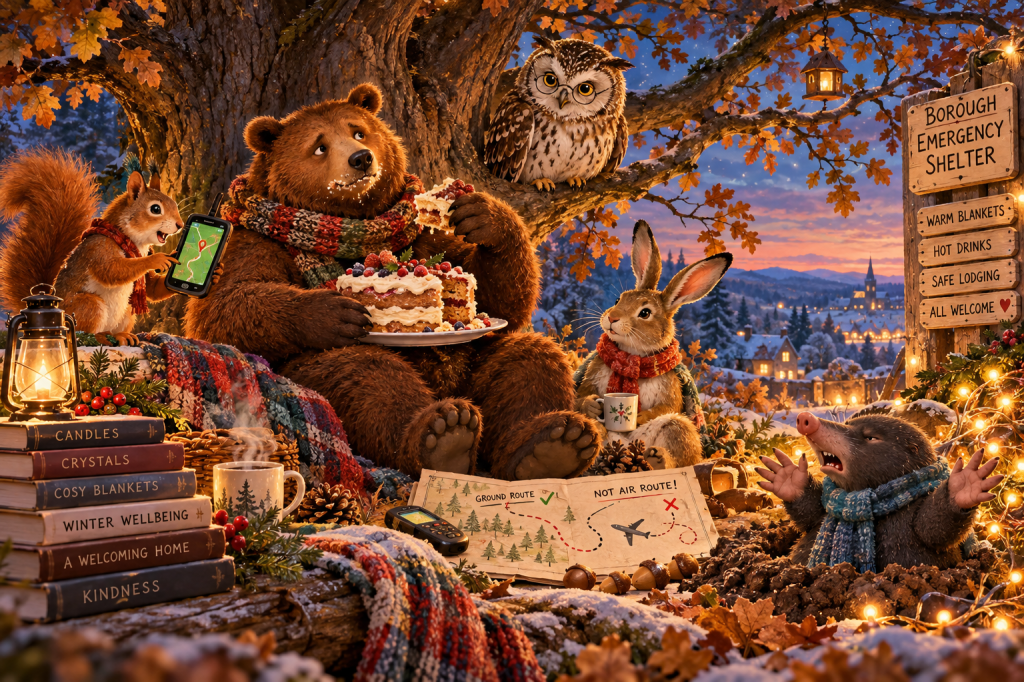
An Extra Place at the Table
As the afternoon grew colder, the rabbit spoke about something she considered more important than candles, crystals or the perfect arrangement of cushions.
“Winter can be difficult for those who find themselves alone, lost or without a safe place to shelter. We should remember that making a home warm is not only about what we put inside it. It is also about whether we leave room for someone else.”
She explained that the borough would always try to find emergency shelter for any woodland creature caught out by the weather. There were spare burrows, blankets and warm corners available for those who needed them.
“Not everyone has a comfortable den waiting for them,” she said. “A little kindness can make the difference between feeling forgotten and feeling welcome.”
The bear nodded. He understood the appeal of a warm place to retreat to, especially when the wind began to whistle through the trees.
“Everyone should have somewhere safe to curl up,” he said. “Preferably with soup.”
“And cake?” asked the squirrel.
The bear looked mildly offended. “I am discussing shelter, not catering.”
“Of course,” said the rabbit. “Although I suspect your emergency accommodation policy would need a substantial food budget.”
“A well-fed guest is a happy guest.”
“A well-fed bear,” the mole murmured, “is a geological event.”
The Squirrel’s Winter-Proofing System
The squirrel had been unusually quiet for several minutes, which was generally a sign that he was preparing to announce something complicated.
“I have upgraded my winter storage system,” he declared. “Every stash is now tracked by GPS.”
The others stared at him.
“Every single one?”
“Every single one. Nuts, seeds, dried berries. I have coordinates, routes and digital records. Nothing will be lost this winter.”
The owl looked impressed. “That sounds remarkably organised.”
“It is. I have even considered altitude.”
The bear slowly lowered his head. “Altitude?”
“Advanced tracking. Three-dimensional positioning. The future of food storage.”
“Your food is buried in the ground,” the mole pointed out. “Why would you need altitude?”
“Because technology should never be limited by conventional thinking.”
The squirrel looked so pleased with himself that nobody had the heart to explain the obvious problem: a GPS system might tell him where a stash was supposed to be, but it could not guarantee that his little paws would interpret the information correctly. Nor would it help much if he managed to record the wrong location in the first place.
“Still,” said the owl diplomatically, “a good record can be useful, provided the system is reliable and you know how to use it.”
The bear shook his head. “I shall stick to the traditional method. I put food in my den, remember where I put it, and eat it.”
“Your system has one significant weakness,” said the squirrel.
“Only one?”
“You tend to eat the evidence before winter begins.”
The bear decided that this was an unnecessarily personal observation.
The Unfairness of Fat Bear Week
The bear had been staring into the middle distance with the expression of someone contemplating a grave injustice. Beside him sat an entire cake, from which he was taking substantial bites.
“I still cannot believe it,” he said at last. “All that preparation. All that eating. All those berries, nuts, salmon and honey. I worked incredibly hard to put on enough weight for winter, and did I win Fat Bear Week?”
“No,” said the owl gently.
“No,” the bear repeated, taking another bite of cake. “My cousin won. Backpack. Bear 89. The famous one. Apparently, being a perfectly respectable bear with excellent winter reserves is no longer enough. One must also have a public relations strategy.”
“Backpack is a real champion,” the squirrel pointed out. “He won the 2026 Fat Bear Week contest.”
“I am aware of the facts,” said the bear. “I have been living with the facts for days. I ate four dinners in one day. Four. I have been consuming salmon with the dedication of a bear who understands his professional responsibilities. I even increased my cake intake.”
“Your cake intake was already considerable,” the rabbit observed.
“Exactly. I went above and beyond.”
The bear took another forkful, looking down at the cake as though it had personally betrayed him.
“I suppose the public has never seen me eat a whole cake in one sitting,” he added thoughtfully. “Perhaps that is where my campaign went wrong.”
The squirrel brightened. “I could track your progress with GPS. We could record your weight, food intake and daily movements. I could even map your cake consumption.”
“Will it give me my coordinates in the air again?”
“That was one minor technical issue.”
“If your system reports that my cake is three hundred metres above the forest, I shall eat the device.”
The owl folded his wings. “The contest is entertaining, but its title does not determine whether you have prepared well for winter. What matters is that you have enough reserves to survive it.”
The bear considered this while removing the last substantial piece of cake from the plate.
“You are right, of course,” he said. “I shall be the champion of my own den.”
“At this rate,” said the mole, “you will be the champion of every den in the borough.”
The rabbit sighed. “I shall need to revise the emergency accommodation policy. We may have to introduce a clause about competitive cake consumption.”
The bear looked offended, although he made no attempt to deny the charge.
“Next year,” he announced, “I shall return stronger, rounder and better prepared.”
“Perhaps you could begin by eating a little less cake,” suggested the owl.
The bear stared at him in disbelief.
“Let us not become unreasonable.”
A Bear’s Farewell
By now, the afternoon light had begun to fade. The bear stood, brushed a few crumbs from his fur and looked around at his friends.
“It is nearly time for me to settle into my den,” he said. “I have blankets to arrange, supplies to organise and a reputation to rebuild.”
“Try to leave some food for spring,” the squirrel advised.
“I shall do my best.”
“And perhaps reconsider the GPS,” added the mole.
“No promises.”
The rabbit smiled. “Sleep well, bear. We shall see you when the weather turns.”
The bear gave a solemn nod. “Until then, may your homes be warm, your blankets plentiful, your soup comforting and your cakes of a respectable size.”
“Define respectable,” the squirrel asked.
The bear glanced at the empty cake plate.
“I shall leave that to future research.”
As he lumbered towards his den, the others watched him disappear between the trees. The owl remained on his branch, the rabbit began gathering the last of the fallen leaves, and the mole retreated underground with the satisfaction of someone whose winter would at least be free of fairy lights.
The squirrel checked his GPS.
“Curious,” he murmured. “It says the bear is currently located somewhere above the canopy.”
Nobody asked him to explain.
Winter was coming, and there were still blankets to find, homes to prepare and neighbours to look after. The woodland would grow quieter, the evenings darker and the need for warmth more pressing. Yet there was comfort in knowing that a little light, a shared meal, a spare blanket or an open door could make the season gentler.
After all, winter-proofing a home is one thing. Winter-proofing a heart is quite another.


Leave a Reply