An unfortunate reputation, a question of intelligence, and the owl who got all the credit.
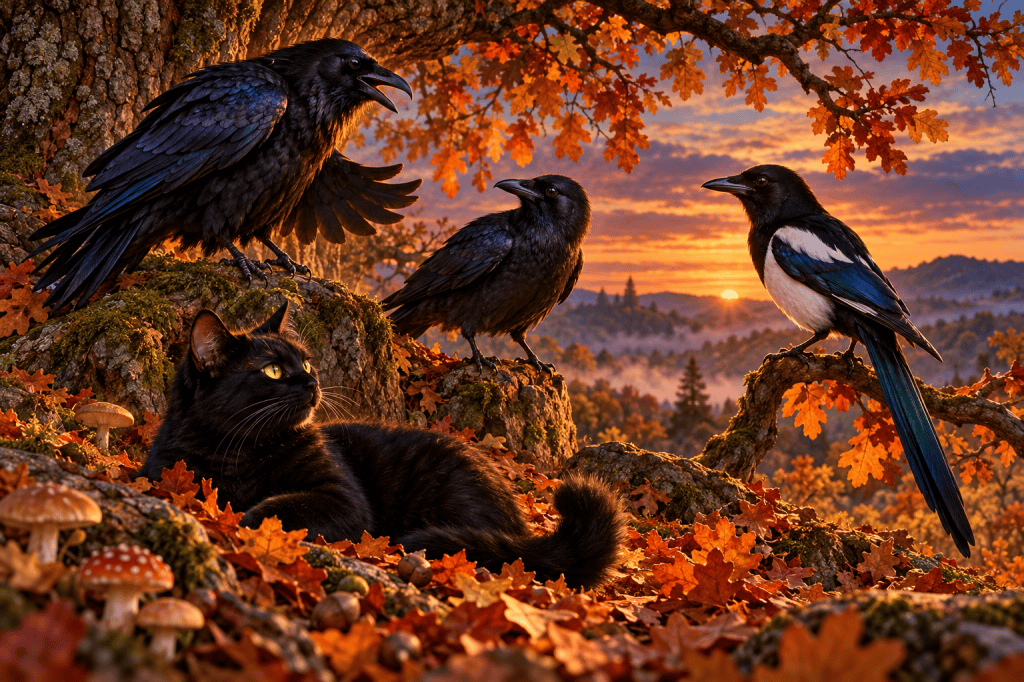
Autumn had settled over the ancient oak, scattering copper and gold across the woodland floor. As the afternoon sun retreated behind the hills, three birds gathered beneath the branches for what the raven insisted was an important discussion. The crow called it a meeting of the misunderstood, while the magpie considered it an opportunity to correct several centuries of malicious gossip.
A black cat sat quietly among the fallen leaves, his tail curled neatly around his paws. He had arrived without invitation and appeared entirely uninterested in the proceedings.
A Reputation in Ruins
“I believe we have been victims of one of the longest-running character assassinations in literary history,” the raven began solemnly.
“You mean the business with death, darkness and impending doom?” asked the crow.
“Precisely. A raven appears on a castle battlement, and suddenly everyone expects someone to die. Even my perfectly ordinary call is interpreted as a warning from beyond the grave.”
“You can thank Edgar Allan Poe for some of that,” remarked the magpie. “One bird says ‘Nevermore’, and suddenly an entire species becomes responsible for humanity’s existential despair.”
The raven ruffled his feathers indignantly. “I have an extensive vocabulary, thank you. I simply refuse to waste it on people who insist on asking depressing questions.”
The crow tilted his head. “At least you get dramatic poetry. I’m accused of bringing bad luck merely by landing on a fence.”
“And I have been convicted of stealing jewellery without so much as a fair trial,” declared the magpie. “Studies have even challenged the popular belief that we’re irresistibly attracted to glittering objects. Apparently, we can be just as cautious around unfamiliar shiny things as anyone else.”
“So the jewellery business is exaggerated?” asked the crow.
“Wildly. Although I reserve the right to investigate an interesting button.”
Below them, the cat’s left ear twitched.
The Wisdom Scandal
The raven hopped onto a lower branch, his dark feathers catching a faint blue sheen in the fading light. “What truly puzzles me is how the owl managed to acquire the entire reputation for wisdom.”
The crow chuckled. “Large eyes. Serious expression. Sits quietly at night looking as though he’s contemplating the universe.”
“He’s contemplating a mouse,” said the magpie.
“Quite possibly,” agreed the raven. “Yet humans have associated owls with wisdom for centuries, particularly through Athena, the ancient Greek goddess of wisdom. An excellent arrangement for the owl, who appears to have secured the title without submitting his qualifications.”
“Meanwhile,” said the crow, spreading his wings, “we corvids have been solving problems that would leave half the woodland scratching their heads.”
There was considerable truth in this complaint. Ravens, crows and magpies belong to the corvid family, whose members rank among the most cognitively sophisticated birds studied by scientists. Different species have demonstrated tool use, complex problem-solving, social learning and impressive memories.
“New Caledonian crows can manufacture tools and solve problems requiring several steps to reach a reward,” the crow continued. “Some crows can even recognise individual human faces and remember which people have treated them badly.”
“A useful talent,” observed the magpie. “Considering how many humans seem convinced we’re plotting against them.”
“Ravens have demonstrated the ability to plan for future situations in experiments,” added the raven. “We also remember social relationships and distinguish between individuals.”
“And magpies?” asked the crow.
“We recognise opportunities. Apparently, that’s called intelligence when humans do it and suspicious behaviour when we do.”
The raven nodded gravely. “Of course, parrots also deserve a place in the conversation. It would be unscientific to declare ourselves the three cleverest birds in existence.”
“Fine,” said the magpie. “Although parrots don’t have our public-relations problem. Humans teach them to swear and then applaud.”
The cat’s tail moved slowly from side to side.
The Problem with Black
“Perhaps our reputation has less to do with our behaviour than with our colour,” suggested the crow.
“Ah, yes. Black,” said the raven. “Humanity’s favourite colour to misunderstand.”
Death, danger, witchcraft and misfortune: the magpie reeled off the familiar associations. Yet black has carried very different meanings across cultures and throughout history. In many European traditions, it became associated with mourning, solemnity and death, while also representing authority, wealth, refinement and elegance. Because rich black dyes were once expensive to produce, black garments could signify considerable status.
“So a human dressed entirely in black can be considered sophisticated, while a bird born wearing the same colour is considered sinister?” asked the magpie.
“Apparently,” replied the raven.
“That seems an exceptionally poor system of classification.”
The crow glanced down at the cat. The cat looked back, and one ear twitched.
“Consider our silent companion. In some traditions, black cats are regarded as unlucky; in others, they’re associated with good fortune. In parts of Scotland, the arrival of an unfamiliar black cat has traditionally been considered a good omen.”
The magpie studied the cat, who had begun washing one paw. “He doesn’t look particularly interested in anyone’s fortune.”
“Perhaps he’s already made his,” said the raven.
Water, Wisdom and the Colour of Night
“There’s something else humans tend to overlook,” the crow continued. “In traditional Chinese thought, black is associated with Water, one of the Five Phases, or Wu Xing.”
“Water? Not darkness and doom?” asked the magpie.
“In Feng Shui, black and deep blue are commonly associated with Water and the northern direction. Water can suggest depth, adaptability and movement. Some modern Feng Shui interpretations also connect the northern area of a home with career and life path.”
The raven considered this. “A colour associated with depth and reflection. That sounds considerably more flattering.”
“Black is also associated with yin,” the crow explained, “which encompasses qualities such as receptivity, stillness and night. Yin isn’t inherently negative. It exists in relationship with yang, each complementing the other.”
“So black isn’t the villain of the colour spectrum,” concluded the magpie.
“Not unless someone insists on writing it that way.”
The raven gazed towards the darkening woodland. “Ancient Egypt offers another interesting example. Black could symbolise fertility and renewal because of the rich, dark silt deposited by the Nile. Osiris, associated with death and rebirth, was sometimes depicted with black skin to express regeneration.”
The magpie blinked. “Death and new life represented by the same colour?”
“Nature has never been particularly interested in keeping human categories tidy,” replied the crow.
The raven spread one wing. “And look at our feathers. Humans call us black, yet sunlight reveals blue, violet and green iridescence. Even the colour they think they understand refuses to remain simple.”
“Mine are black and white,” the magpie reminded him, “with a magnificent metallic sheen. I prefer to think of myself as a walking argument against oversimplification.”
A Murder of Misunderstandings
By now, the sun had disappeared, and the woodland was slipping into the blue-grey stillness of evening. The magpie had been unusually quiet for several moments, which the crow found mildly alarming.
“There’s another matter,” she announced. “Collective nouns.”
The raven sighed. “Must we?”
“A murder of crows. An unkindness of ravens. Humans couldn’t simply call us a gathering?”
“Those are traditional, often fanciful collective nouns,” the crow explained. “They aren’t scientific descriptions of our personalities. A group of crows is still perfectly acceptable.”
“Then I propose a misunderstanding of corvids,” said the magpie.
“Or a conspiracy,” suggested the raven.
“That would only make matters worse,” the crow replied.
The cat’s tail swished once.
The magpie looked down. “And what about him? Black cats have been accused of everything from bringing misfortune to accompanying witches. Surely he has an opinion.”
The cat continued examining his freshly washed paw.
“He’s remarkably restrained,” observed the raven.
“Perhaps,” said the crow, “he understands something we don’t.”
The magpie stared at the cat for a moment. “Or perhaps he’s simply ignoring us.”
The Colour Has the Last Word
A cool breeze moved through the oak, loosening another shower of autumn leaves. The raven settled deeper into his feathers while the crow watched the first stars appear above the branches.
“It seems humans have spent centuries deciding what we represent without paying much attention to what we actually are,” the raven said.
“They fear our colour while wearing it to appear powerful,” added the crow. “They call us ominous, yet study our intelligence with fascination. They praise wisdom in an owl but often overlook it in the birds they consider troublesome.”
“And they accuse me of stealing shiny objects,” the magpie said, “while digging diamonds out of the earth to hang around their own necks.”
The raven considered this argument. “An excellent point.”
“Thank you. I’ve been saving it.”
For a while, none of them spoke. The woodland had grown almost completely dark, although the last traces of twilight still shimmered across their feathers.
“Perhaps black isn’t the problem,” the crow said at last. “Perhaps the problem is humanity’s determination to make a single colour stand for a single idea.”
The raven nodded. “Darkness can conceal danger, but it can also offer rest. Black can signify mourning or elegance, mystery or authority, endings or beginnings. The meaning changes with the culture, the circumstances and the person looking at it.”
“And sometimes,” the magpie added, “black is simply the colour of a very intelligent bird who would appreciate a little respect.”
Beneath the oak, the cat rose, stretched luxuriously and gave his tail one final, deliberate swish before disappearing into the shadows.
“Not a word from him all afternoon,” remarked the crow.
“Remarkable self-control,” said the raven.
The magpie tilted her head. “Do you suppose he agrees with us?”
The raven watched the place where the cat had vanished. “I suspect he has never considered our approval necessary.”
Somewhere beyond the oak, an owl called into the darkness.
The magpie rolled her eyes.
“Oh, listen. The wise one has arrived.”
More Oak Tree Conversations
The Many Faces Of Orange


Leave a Reply