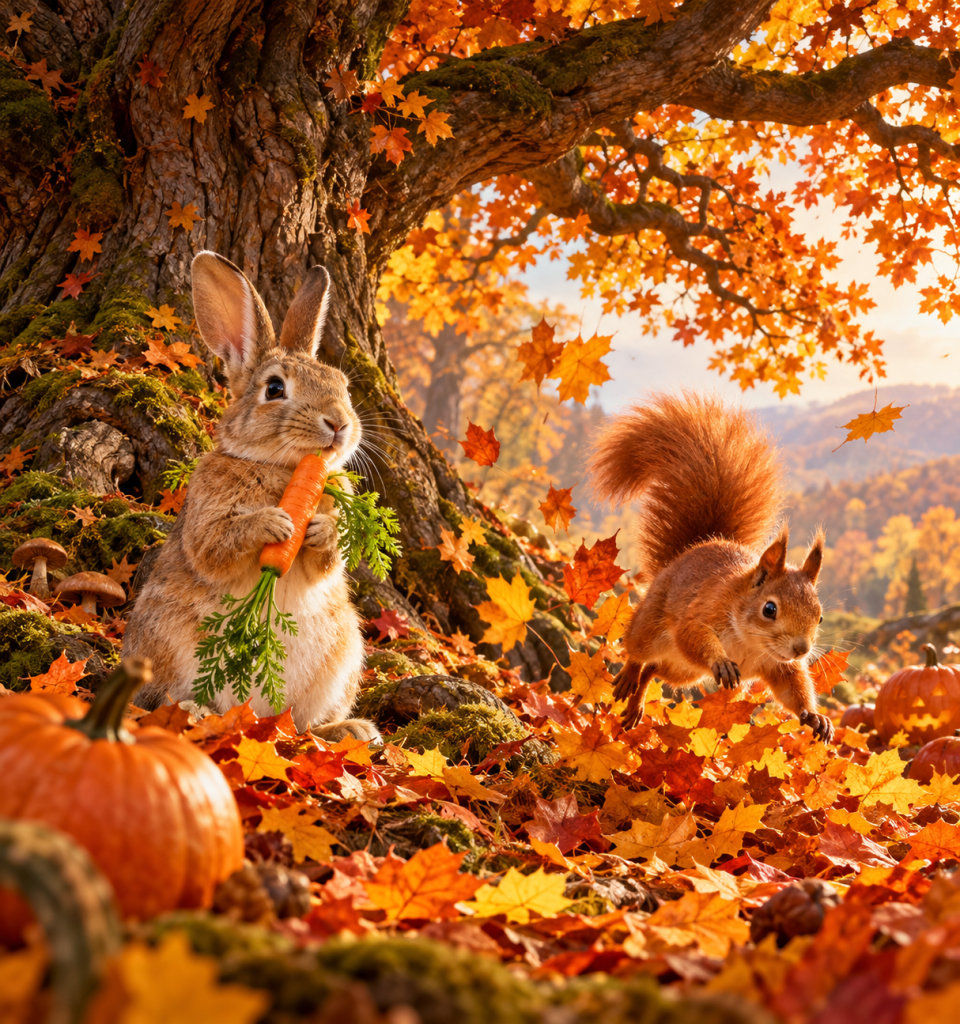
The old oak had dressed for autumn. Its great branches displayed leaves in shades of amber, copper, gold, and orange, while others drifted to the ground among mushrooms, acorns, and forgotten hazelnuts. A few pumpkins had appeared near the roots, although nobody remembered who had brought them there.
Beneath the tree sat a rabbit, holding a carrot between his paws and appreciating the prospect of a good lunch. Nearby, a squirrel was having a more energetic relationship with the season. He leapt between branches, kicked through piles of golden leaves, and launched himself onto a low-hanging bough, sending a shower of orange foliage spiralling towards the rabbit.
“Must you make it rain leaves?” the rabbit asked.
“I am merely assisting nature,” the squirrel replied, landing in a heap of foliage. “Autumn is magnificent! Orange leaves, pumpkins, berries—”
“Mushrooms are not generally orange, and some are poisonous.”
“Then I shall admire them from a distance.”
Settling beside the rabbit, the squirrel surveyed the clearing. “Have you ever wondered why orange is such an important colour? Autumn, Halloween, happiness, Feng Shui, positive energy. It seems to mean something everywhere.”
The rabbit took another bite of his carrot. “Perhaps humans simply cannot look at a colour without deciding it must represent something.”
“An excellent theory. We should investigate.”
The rabbit sighed. His afternoon had clearly taken a turn.
A Colour Called Autumn
“Why do leaves turn orange?” the squirrel asked.
“As trees prepare for winter, decreasing daylight and changing temperatures trigger the breakdown of chlorophyll, the green pigment that helps leaves capture sunlight. As the green fades, carotenoids reveal yellow and orange shades, while anthocyanins can produce red under certain conditions. The colours depend on the tree species, weather, and environment.”
“So the trees are not decorating themselves for Halloween?”
“Not intentionally. They are responding to the seasons. Humans are the ones who turn it into a celebration, decorating houses, gardens, cakes, and occasionally dogs that would rather be left alone.”
The squirrel nodded solemnly. “I have seen those costumes. It is a troubling business.”
They watched a golden leaf drift through the air. “Still, these colours make the woodland feel warm, even when the air grows colder,” the squirrel observed.
“Orange can evoke sunlight, fire, ripe fruit, and the harvest. It is often associated with warmth, energy, enthusiasm, and abundance.”
“So autumn is nature’s cheerful farewell before everything turns brown?”
“Or nature is simply getting on with its business while humans assign meaning to the result.”
The squirrel grinned. “Which is why we make such an excellent team.”
The rabbit returned to his carrot, wisely deciding not to disagree.
Pumpkins, Lanterns, and Halloween
“Speaking of celebrations, Halloween!” The squirrel sprang to his feet, scattering leaves.
“I knew we would get there,” the rabbit remarked.
“Orange and Halloween are practically inseparable. Pumpkins, lanterns, decorations, sweets. Why orange?”
“Pumpkins became closely associated with Halloween in North America, where carved jack-o’-lanterns developed into one of the season’s most recognisable symbols. The older tradition of carving lanterns from vegetables has roots in Ireland and Britain, where turnips and other root vegetables were used. Irish immigrants carried these customs to North America, where pumpkins were more readily available and easier to carve.”
“Have you ever tried hollowing one out?” the squirrel asked.
“I have watched humans attempt it. There is a great deal of scraping, muttering, and misplaced optimism.”
The squirrel wisely refrained from volunteering.
“Orange also looks splendid beside black,” he continued. “Bright leaves against dark evenings, firelight against the night.”
“Exactly. The contrast evokes autumn’s warmth against the approaching darkness. Orange suggests harvest and life, while black evokes night, mystery, and the unknown.”
“Which explains why pumpkins look cheerful rather than frightening?”
“Sometimes. It depends on the face carved into them.”
“I prefer the sinister ones. They look as though they know a secret.”
“Perhaps they know what happened to the missing acorns.”
The squirrel’s grin vanished. “That is not funny. I take my winter provisions seriously.”
The rabbit wisely avoided the subject of the squirrel’s suspiciously disorganised storage habits.
Orange and Positive Thinking
The squirrel settled against the oak’s trunk. “Humans say orange is a positive colour. Does wearing it make you happy?”
“Not automatically. Colour responses depend on personal experience, culture, context, and individual preference. Some people find orange energetic and cheerful; others find it overwhelming.”
“How can a colour be overwhelming?”
“Imagine a room with orange walls, curtains, furniture, and cushions.”
The squirrel shuddered. “I would like to leave.”
“Then you understand.”
In contemporary colour psychology and design, orange is often associated with enthusiasm, creativity, warmth, sociability, and playfulness. Its brightness attracts attention, while softer shades such as peach and terracotta can feel gentler and more grounded.
“So if I paint my nest orange, I shall become more creative?”
“You might simply have an orange nest.”
“Your approach to self-improvement is disappointingly literal.”
“Would you prefer a promise that orange paint will transform you into a genius?”
“Only if it comes with scientific evidence.”
The rabbit watched sunlight illuminate a patch of orange leaves. “Perhaps the colour’s positive associations come partly from what it reminds us of: sunshine, ripe fruit, celebrations, warmth, and shared meals. These associations can be powerful without the colour possessing magical properties.”
“So orange does not manufacture happiness. It reminds us of things that make us happy.”
“Precisely.”
“I shall put that in my notebook.”
“You have a notebook?”
“Of course. I am a squirrel of considerable intellectual ambition.”
“What do you write in it?”
“Mostly reminders about where I put my acorns.”
The rabbit decided not to ask whether it was helping.
A Little Feng Shui
“What about Feng Shui?” the squirrel asked. “Humans use colours in their homes to influence the atmosphere.”
“Some Feng Shui practitioners associate orange with warmth, enthusiasm, sociability, and activity. Its elemental association varies by shade and interpretation. Bright, fiery oranges are often linked to Fire, while earthy shades such as terracotta and rust may be associated with Earth.”
“Fire and Earth. Dramatic.”
“Only if you put them in the wrong place.”
“Is there a wrong place for orange?”
“Feng Shui considers the arrangement of spaces, directions, elements, and other factors. It is not simply a colour chart assigning every shade to one particular room.”
The squirrel surveyed the clearing. “Would orange suit a woodland gathering place?”
“That depends on the purpose of the space. A vivid colour can create energy and draw attention, while muted terracotta or warm amber may feel more grounded. Feng Shui offers one traditional framework for thinking about atmosphere, though its associations should not be confused with scientifically established effects.”
“Nature seems to have got the balance right.”
“Nature did not consult a decorating manual.”
“Perhaps it should publish one. I suspect it would sell rather well.”
The Orange Prison Problem
For a while, the rabbit finished his carrot while the squirrel untangled a leaf from his tail. Then the squirrel frowned.
“There is something else about orange that bothers me. It represents warmth, creativity, and autumn, yet humans also dress prisoners in it. Why would a cheerful colour become a prison uniform?”
“Because the purpose of the clothing matters more than the symbolism. Some correctional facilities, particularly in the United States, use bright orange uniforms because they are highly visible. This helps staff identify people in custody and spot them more easily if they escape. Uniform colours vary between jurisdictions and institutions; orange is certainly not universal.”
“So orange is a warning?”
“More a practical means of identification.”
The squirrel glanced at his russet fur. “I am relieved to hear that. I have occasionally entered the farmer’s shed without permission.”
“You are a squirrel.”
“A squirrel with a complicated relationship with property rights. I prefer to call it an informal redistribution programme.”
“Perhaps you should stop borrowing walnuts without asking.”
The squirrel ignored this suggestion. “So the same colour that suggests warmth and enthusiasm in one setting can signal confinement and make someone conspicuous in another?”
“Precisely. Orange in a pumpkin evokes harvest and Halloween; in interior design, it might suggest energy or welcome; on a prison uniform, it serves a practical purpose unrelated to happiness.”
The squirrel looked down at the leaves. “Perhaps colour is less about what it means and more about what people use it to mean.”
“Now you are thinking.”
“I was thinking before. I was simply thinking about walnuts.”
“Of course.”
The squirrel studied the woodland. “Imagine humans interpreting every colour here: green for life, brown for earth, gold for abundance, orange for autumn, black for mystery.”
“They would probably write a book.”
“Or sell decorative cushions.”
The squirrel shuddered. “Orange cushions. Everywhere.”
The Colour Has the Last Word
The afternoon light softened, illuminating the oak’s amber and golden leaves. A breeze sent another cascade of orange drifting through the clearing, and one leaf landed on the rabbit’s ear.
“You have an orange leaf on your head,” the squirrel observed.
“I know.”
“Does it make you feel more cheerful, creative, or spiritually aligned with the changing seasons?”
The rabbit removed the leaf. “It makes me aware that a leaf has landed on my ear.”
The squirrel considered this. “You make philosophy difficult.”
“Not at all. The world is full of meaning. We simply need to remember that the meaning we give something is not always the same as the thing itself.”
For once, the squirrel fell silent. “Perhaps that is why orange is so interesting. It can represent autumn, harvest, celebration, energy, and warmth. It can also identify a prisoner, attract attention, or simply be the colour of a carrot.”
“Exactly. Its associations depend on the circumstances.”
“I think I prefer it as a pumpkin. Pumpkins do not require me to understand Feng Shui, colour psychology, or the correctional system before I can appreciate them.”
“A sound conclusion,” the rabbit agreed.
The squirrel launched himself into the leaves, scattering a final shower of orange and yellow across the clearing. The rabbit gathered his remaining carrot scraps and settled against the oak’s roots while the old tree continued its quiet transformation, surrendering one leaf at a time to the season.
The oak did not know that its colours symbolised abundance, inspired artists, or became associated with Halloween. It simply followed the rhythm of the year. Perhaps that was the most useful lesson of all: colours carry history, tradition, emotion, and cultural meaning, but they need not obey any of them. Sometimes orange is a symbol, sometimes a warning, and sometimes simply a leaf falling from a tree.
For a rabbit, it might just be a carrot—which, as far as he was concerned, was quite enough.
More Oak Tree Conversations


Leave a Reply