
The hopes, blessings and suspiciously convenient symbolism humans attach to food
The raccoon had discovered a feast.This was not unusual. Raccoons discovered feasts everywhere. A discarded sandwich, an unsecured rubbish bin, an unattended picnic basket: all were perfectly legitimate invitations in his personal philosophy of life. Humans might disagree, but humans had peculiar ideas about ownership.
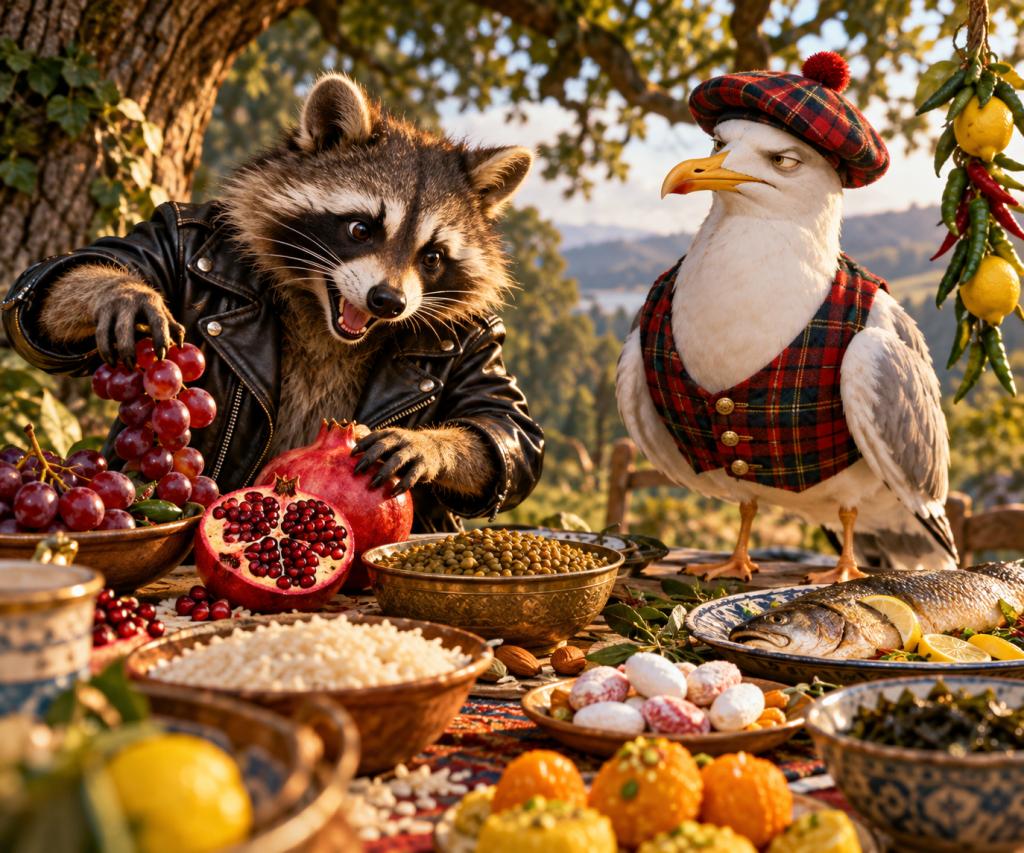
This particular feast, however, was different. Beneath the old oak tree stood a table laden with grapes, pomegranates, rice, lentils, fish and an assortment of sweets. Everything had been arranged with suspicious care, and several items appeared to have been selected for reasons that had nothing whatsoever to do with hunger.
The raccoon circled the table, his nimble paws never still. He rolled a grape between his fingers, lifted a pomegranate to inspect its underside, nudged a bowl of lentils and ran his paws along the edge of a serving dish. He seemed physically incapable of looking at anything without touching it.
The seagull landed beside him and inspected the fish. He was a study in stillness. His feet were planted firmly, his body composed, his wings folded neatly against his sides. Only an occasional flap disturbed his posture. His eyes, however, were perpetually on the move, flicking between the fish, the raccoon’s paws and every possible escape route. He missed very little, particularly when food was involved.
“Excellent. Someone’s organised a sensible meal,” said the seagull.
The raccoon was already rolling a grape between his paws and inspecting a pomegranate. “Na, siehste! Dat is no ordinary meal, wa? Look at all this. Somebody put thought into it.”
“Aye. Someone was hungry.”
“Ach, Mensch! That’s what you think. Humans attach meanings to food. Been doing it for centuries, wa?”
The seagull’s eyes shifted from the grape to the pomegranate. “Secret meanings to lunch? They’re an odd lot, humans.”
“Dat is exactly what I’m saying!”
Seeds, Coins and Wishes
The raccoon picked up a pomegranate and rotated it between his paws, studying its leathery skin as though the answer to a great mystery might be hidden beneath it.
“Take this. All them seeds, wa? Fertility, abundance, prosperity. The fruit practically advertises plenty.”
“Efficient advertising,” the seagull observed, his eyes still fixed on the fruit.
“Na, obviously! You don’t need a marketing department when you’ve got that many seeds.”
“In Greek mythology, the pomegranate is associated with Persephone and the underworld. In Greece, smashing one at the threshold around New Year is a custom linked to good fortune and abundance.”
The raccoon set the fruit down, then immediately rearranged the grapes beside it.
The seagull’s gaze followed every movement.
“So they smash perfectly good fruit on the floor to encourage prosperity?”
“Some do.”
“Wouldn’t eating it be more prosperous? At least ye’d get breakfast.”
The raccoon ignored the criticism and began inspecting the grapes one by one.
“In Spain, people eat twelve grapes at midnight on New Year’s Eve, one with each clock chime. Each represents a month of the coming year, and the custom is associated with good luck. In Portugal, twelve raisins serve a similar purpose, often accompanied by a wish for each month.”
The seagull tilted his head. His eyes flicked towards the nearest grape.
“Twelve grapes in twelve chimes? Sounds like a choking hazard.”
“Na ja, then chew faster! What d’ye want me to say, wa?”
“So is chewing, apparently.”
“Exactly! Ick knew you’d understand eventually.”
The raccoon slipped a grape into his mouth and continued his research.
“Then there are lentils. In Italy, they’re traditionally eaten around New Year because their shape resembles little coins. They’re associated with prosperity and often served with cotechino or zampone, traditional pork preparations.”
The seagull stared at the lentils, then shifted his gaze towards the fish.
“Currency wi’ nutritional value. Finally, a sensible economic system.”
“Dat is what I’m telling you! Money you can eat. Finally, somebody in charge has had a sensible idea.”
“I’m no sure the bank will accept a bowl of lentils as a deposit.”
“Then you’ve got the wrong bank, mein Freund.”
The raccoon moved on to the rice, running it through his fingers before returning it to the bowl.
“Rice also represents abundance, fertility and good fortune in many cultures. In various parts of the world, rice or other grains have traditionally been thrown over newlyweds as a wish for prosperity and fertility. The particular customs vary by region.”
The seagull remained planted in place, although his eyes followed the raccoon’s paws as they drifted towards the bowl.
“So when humans throw food at each other, it might be a blessing rather than an argument.”
“Sometimes.”
“Aye. I’ll remember that next time someone throws a sandwich at me.”
“Please don’t encourage them.”
The raccoon moved on to the fish, lifting the serving dish just enough to peer underneath it.
“Fish is another familiar symbol of prosperity, particularly around Chinese New Year. In Chinese, the word for fish sounds like the word for surplus, so serving it expresses the hope that there will be more than enough in the coming year. Some traditions leave a little uneaten to symbolise abundance carrying forward.”
The seagull’s eyes widened. For the first time, his composure nearly faltered.
“They deliberately leave fish behind?”
“Ja.”
“After hoping for more fish?”
“Dat is the symbolism, wa?”
The seagull gave one decisive flap of his wings.
“Aye, well, I’m happy to help them fulfil their wishes.”
The raccoon quietly moved the platter out of reach.
“Na, na. Hands off the fish, Scotland. We’re still researching.”
A Bowl for Every Occasion
By now, the raccoon had touched nearly everything on the table. He straightened a dish of grapes, lifted a bowl to inspect its contents and rolled a lentil between his fingertips. His paws seemed to operate independently of his thoughts, driven by a curiosity that was difficult to distinguish from the urge to acquire.
The seagull barely moved. His folded wings and steady stance suggested patience, but his restless eyes betrayed him. He was monitoring the food, the raccoon and the surrounding woodland simultaneously.
“Food symbolism isn’t confined to New Year,” the raccoon continued. “Meals also mark births, birthdays, weddings and other milestones. Sharing food lets families and communities take part in important moments.”
“Or get a free meal,” the seagull remarked.
“Na, don’t pretend that’s not part of the appeal.”
“In Korea, seaweed soup, known as miyeokguk, is traditionally eaten after childbirth and is also associated with birthdays. The birthday custom connects the soup with remembering the mother’s experience of childbirth and the care involved in bringing a child into the world.”
The seagull’s eyes settled on the soup bowl.
“So the meal remembers the person who gave the birthday celebrant their first day. That’s rather thoughtful.”
The raccoon paused, a small dish balanced between his paws.
“Exactly. Dat’s the lovely part, wa?”
For a moment, neither animal spoke.
Then the seagull’s gaze dropped towards the bowl.
“Does it contain fish?”
The raccoon sighed. “Seaweed, among other possible ingredients.”
“Aye, worth asking.”
The seagull’s attention shifted to a dish of sugared almonds. The raccoon had already picked one up, turned it over and was examining its sugary coating.
“These are familiar in parts of Europe,” he explained. “Sugared almonds are traditionally given at weddings and baptisms in countries including Italy, Greece and Cyprus. The almond can symbolise fertility, new life or good fortune, while the sugar represents the sweetness wished for the occasion.”
“An almond wearing a sugar coat,” the seagull observed. “A rather optimistic disguise.”
“Na, it’s clever. Dress something up nicely and suddenly it means five different things.”
“In Italy, five sugared almonds, known as confetti, are traditionally associated with health, wealth, happiness, fertility and long life.”
The seagull counted the almonds with a sharp sideways glance.
“Five wishes, five almonds. I suppose it would be greedy to eat all five.”
“Guests are generally expected to eat them.”
“Aye, finally, a ritual I can wholeheartedly support.”
The raccoon swiftly moved the dish closer to himself.
“Wedding food can carry practical as well as symbolic meaning. Bread, grains and shared dishes may represent hospitality, unity and the hope that a couple will never lack nourishment. The customs differ between regions and families, and their meanings have evolved over time.”
“Which means if I attend a wedding, I can reasonably expect food.”
“Na, you can reasonably expect not to be invited.”
“Ach, details.”
The Indian Art of Auspicious Eating
The raccoon had just rescued the almonds when the seagull spotted a colourful arrangement at the far end of the table.
There were small round sweets, bright yellow and orange, beside a plate of fruit and a curious string of lemons and green chillies.
The seagull’s eyes sharpened. He remained motionless, but the raccoon was already reaching for one of the sweets.
“What have we here?” the seagull asked.
“Examples of auspicious foods and folk customs found in India. India is enormously diverse, so traditions vary between regions, communities and families. Sweets, however, often play a role in celebrations and new beginnings.”
The raccoon turned a ladoo between his paws before taking a bite.
“Ladoos and other sweets may be shared at festivals, weddings, births and other happy occasions. Offering something sweet can express goodwill and the hope that what lies ahead will be equally sweet.”
The seagull watched the ladoo disappear.
“An edible wish for happiness.”
“Genau!”
“Does the wish still work if ye eat it?”
“Na, of course! The wish doesn’t depend on leaving the sweet untouched. What would be the point of that?”
“Aye, now that’s a tradition with potential.”
The raccoon reached for another ladoo. The seagull’s eyes followed it with unwavering precision.
The raccoon then pointed towards the lemons and chillies.
“Those are different. In a folk custom found in parts of India, a lemon and chillies may be strung together and hung outside homes, shops, vehicles or new premises. They’re traditionally believed to ward off the evil eye or misfortune.”
The seagull inspected the arrangement from a safe distance.
“Lemons and chillies on security duty?”
“Dat’s the idea. Though it’s a folk belief, not a demonstrated protective effect, wa?”
“Aye. Still, I wouldn’t want to annoy a lemon that’s been assigned security duties.”
“Na, best not. You never know.”
The seagull considered the matter, then glanced at the remaining ladoos.
“Does one of those ward off danger?”
“No.”
“Bad luck?”
“No.”
“Hungry seagulls?”
“Absolutely not.”
“Aye, then I’ll have another.”
The raccoon closed his eyes briefly. He had the uncomfortable feeling that this conversation was becoming less about cultural traditions and more about enabling a criminal.
“Na, Mensch. You see? This is why we can’t have nice things.”
The Real Meaning of a Feast
By now, the table looked considerably less abundant than it had when they arrived.
The raccoon surveyed the remaining dishes, his paws busy gathering grapes into a small pile. The seagull surveyed the raccoon, his body still as a statue and his eyes alert to every movement.
“Do you think any of these foods actually bring good fortune?” the raccoon asked.
The seagull considered the question with surprising seriousness.
“I think they bring people together. They give families something familiar to prepare, something to share and something to look forward to. Whether the luck comes from the food itself is another question.”
The raccoon stopped rearranging the grapes.
“Na, that’s almost philosophical, wa?”
“Don’t spread it around. I’ve got a reputation to maintain.”
“Think about it. A pomegranate can’t guarantee prosperity, lentils can’t promise wealth, and twelve grapes can’t control the coming year. But these foods give people a way to express their hopes. They turn an abstract wish into something tangible, something that can be prepared, held and shared.”
The seagull’s eyes narrowed as the raccoon quietly slipped another grape into his mouth.
“Something that can also be stolen.”
“Ach, you’ve missed the point!”
“Aye, I’ve understood it perfectly. I simply refuse to ignore its practical implications.”
The afternoon light shifted beneath the oak. For a little while, the two animals sat quietly beside the table, contemplating the peculiar human habit of attaching enormous significance to ordinary things.
A seed became a promise. A grain became a blessing. A sweet became a wish for happiness. A meal became a celebration of life, family and the possibility that the coming year might be kinder than the last.
Then the seagull noticed one remaining grape.
His body remained still, but his eyes moved from the grape to the raccoon, then back again.
“D’ye think stealing the final grape brings bad luck?”
The raccoon stopped moving his paws and gave the seagull a suspicious look.
“Na, don’t ask me. I’m not the one about to steal it, wa?”
“Probably,” he added, with a shrug.
“Probably?”
“Na, siehste! Go on, then. Test the theory.”
The seagull snatched the grape and swallowed it whole.
“Excellent. Now we’ve got a research question for next year.”
The raccoon stared at him, both paws suspended in midair.
“Na, Mensch! Dat is exactly why nobody invites us anywhere!”
Somewhere above them, an owl began to hoot.
The seagull glanced upwards.
“If that’s the wise one, tell him the fish was delicious.”
The raccoon gathered what remained of the feast and began making a list of corrections for the next gathering. His paws continued to fidget with the edge of the paper as he wrote.
At the very top, he wrote:
Never invite a seagull to a symbolic meal.


Leave a Reply